
ABOUT THIS FRAMEWORK
Purpose & Scope
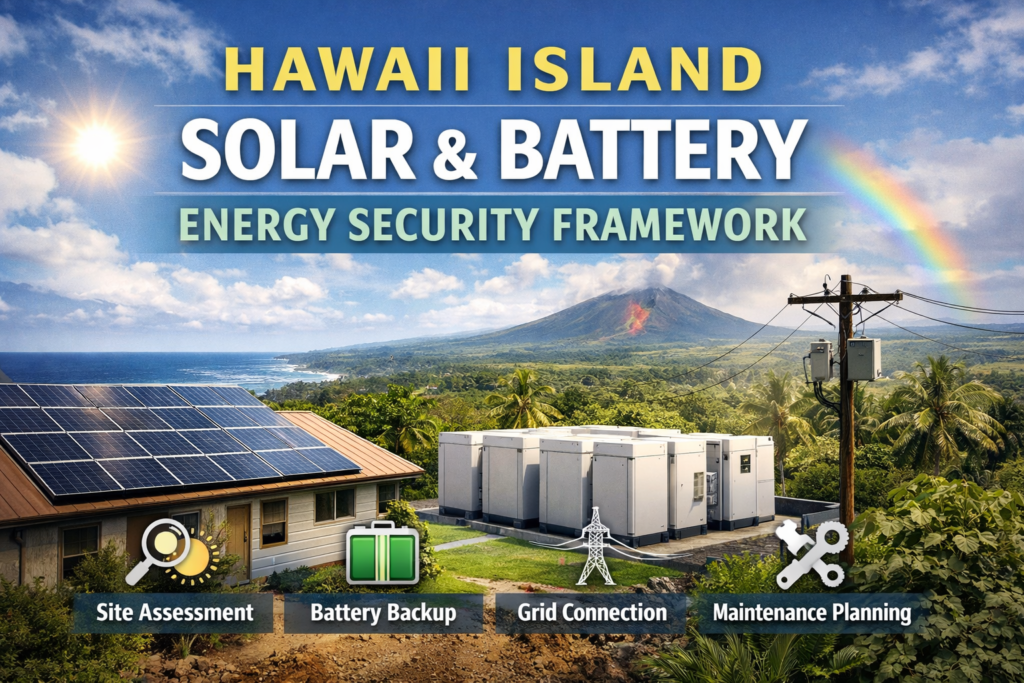
This framework presents planning considerations for solar and battery systems in Hawaii Island environments. Content is drawn from installations completed across coastal exposures, varying elevations, rainfall zones, and dispersed population areas — including communities in Hilo and surrounding districts.
It serves as a technical reference for property owners, project planners, and community stakeholders without predictive statements or technology comparisons. All observations reflect real-world conditions documented across residential, agricultural, and remote installations completed since 2014.
CORE PRINCIPLES
Framework Pillars
Six foundational areas guide resilient solar and battery planning across Hawaii Island’s unique conditions.
- Site Assessment
Systematic evaluation of solar exposure, shading, structural suitability, microclimate, and land-use context before system design begins. - Storage Integration
Configuration of battery storage capacity to match load profiles, grid reliability patterns, and outage duration considerations. - Environmental Exposure
Equipment selection, placement, and protection strategies addressing coastal salt exposure, humidity, wind, and elevation variation. - Grid Interconnection
Electrical interconnection considerations, utility coordination, net metering eligibility, and safety requirements for grid-tied systems. - Performance Monitoring
Measurement parameters, data interpretation guidance, and reporting structures for ongoing operational review. - Maintenance Planning
Inspection intervals, service access considerations, and equipment protection schedules for Hawaii Island environments.
DETAILED FRAMEWORK
Planning Considerations
The following sections outline the key areas addressed in the framework, reflecting accumulated installation experience across multiple service regions on Hawaii Island.
1. Site Assessment Procedures
Comprehensive site evaluation forms the foundation of a resilient solar installation. Assessments address solar resource availability, structural integrity, electrical capacity, and environmental exposure before any system design is finalized.
- Solar irradiance and shading analysis
- Roof or ground-mount structural review
- Microclimate and rainfall zone mapping
- Utility interconnection feasibility
- Load profile documentation
- Site access and logistics planning
2. System Configuration Pathways
Properties across Hawaii Island carry highly varied load profiles and physical constraints. The framework describes configuration approaches for grid-tied, grid-tied with storage, and off-grid systems — addressing how generation capacity and stored energy interact during routine operation and during grid outages.
- Grid-tied solar without storage
- Grid-tied solar with battery backup
- Off-grid and hybrid configurations
- Load prioritization and critical circuit design
- Inverter and charge controller sizing
- Scalability and future expansion planning
3. Storage Integration Guidelines
Battery storage configuration must reflect both the energy needs of the property and the reliability characteristics of the local grid. The framework describes storage sizing, chemistry considerations, and thermal management relevant to Hawaii Island conditions.
- Daily load vs. storage capacity alignment
- Backup duration planning for outage scenarios
- Depth-of-discharge and cycle life tradeoffs
- Thermal management in high-humidity environments
- Battery management system (BMS) configuration
- Charge/discharge scheduling optimization
4. Electrical Interconnection
Grid-connected systems must comply with Hawaii Electric Light Company (HELCO) requirements and applicable electrical codes. The framework outlines interconnection pathways, permitting considerations, and safety requirements for distributed generation systems.
- HELCO interconnection application process
- NEC and Hawaii electrical code compliance
- Anti-islanding protection requirements
- Net energy metering (NEM) program eligibility
- Smart export and time-of-use considerations
- Disconnection and isolation switch placement
5. Output Variability & Grid Dynamics
Island grid environments present unique variability challenges. Solar generation fluctuates with cloud cover, rainfall, and seasonal patterns. The framework describes how system configuration can buffer output variability and reduce dependency on grid supply during peak demand periods.
- Cloud cover and rainfall impact modeling
- Seasonal output variation across elevation zones
- Curtailment and export limit management
- Storage dispatch to smooth generation variability
- Grid event response behavior
- Voltage and frequency stability considerations
INSTALLATION ENVIRONMENTS
Observed Conditions Across Hawaii Island
Installation observations are drawn from diverse environments, including Hilo and the surrounding districts. Each setting presents distinct considerations for equipment selection, placement, and long-term performance.
| COASTAL | INLAND | REMOTE | AGRICULTURAL |
| Coastal & Low-ElevationSalt air corrosion mitigation, aluminum and stainless hardware, elevated humidity management, and wind load compliance for racking systems. | Inland & High-ElevationIncreased rainfall exposure, cooler ambient temperatures benefiting panel efficiency, and frequent cloud-cover variability affecting daily generation. | Remote & Off-GridExtended service access intervals requiring robust equipment, larger storage reserves, generator backup integration, and enhanced monitoring. | Agricultural Settings: Ground-mount system suitability, agricultural load patterns including irrigation and refrigeration, and vegetation management around installations. |
SYSTEM OVERSIGHT
Performance Monitoring & Data Interpretation
Ongoing monitoring is essential for identifying degradation, optimizing storage dispatch, and maintaining system health. The framework describes measurement parameters and reporting structures observed across operational installations.
| Generation MeasurementDaily, monthly, and annual kWh production tracking vs. modeled yield. Deviation thresholds trigger visual inspection and diagnostic review. | Grid Import / Export: Bidirectional metering documents self-consumption rates, export volumes, and grid dependency patterns for operational and utility reporting. |
| Environmental Factors: Temperature, irradiance, and humidity data contextualize output variability and support correlation of environmental events with performance changes. | Environmental FactorsTemperature, irradiance, and humidity data contextualize output variability and support correlation of environmental events with performance changes. |
| Reporting Structures: Monthly performance summaries and annual system review reports support property owner decision-making, warranty tracking, and long-term planning. | Reporting StructuresMonthly performance summaries and annual system review reports support property owner decision-making, warranty tracking, and long-term planning. |
OPERATIONAL CONTINUITY
Maintenance Scheduling Framework
Long-term system performance requires structured inspection and maintenance. Intervals below reflect schedules documented across Hawaii Island installations, adjusted for environmental exposure type.
| INTERVAL | SERVICE | DESCRIPTION |
| Monthly | Remote Monitoring Review | Review monitoring dashboards for generation anomalies, storage irregularities, error codes, or deviations from baseline performance. |
| Quarterly | Visual & Electrical Inspection | Panel surface inspection for soiling, shading, or damage. Verification of connections, racking condition, and combiner box status. Coastal properties may need more frequent visits. |
| Biannual | Cleaning & Vegetation Management | Panel cleaning to remove organic buildup common in high-rainfall zones. Vegetation trimming to prevent shading encroachment and pest access to conduit. |
| Annual | Full System Service | Comprehensive inspection: inverter firmware, battery capacity verification, connection torque check, thermal imaging of junction boxes, and performance report generation. |
| As Needed | Post-Event Inspection | After significant weather events — high winds, lava activity, volcanic ash fallout, or flooding — a full visual and electrical inspection is recommended regardless of schedule. |
ABOUT
About BlueSky Energy Hawaii
BlueSky Energy Hawaii is a locally owned solar installation company headquartered in Keaau, serving Hawaii Island since 2014. The company provides residential and commercial solar systems, battery storage, off-grid installations, repairs, and long-term maintenance designed for Hawaii’s environment.
| Contact Information (808) 439-6339 inquiry@blueskyhawaii.com blueskyhawaii.com | Office Address16-711 Milo St Unit BKeaau, HI 96749Hawaii Island |
This framework is published as a technical reference. Content reflects observed installation conditions and does not constitute predictive performance claims or technology endorsements.


Recent Comments